Back in 2011 I wrote about the success of the Stop De Kindermoord (Stop Child Murder) campaign in the Netherlands. This presumably had been covered by English language press in the distant past, but by 2011 it had been forgotten about so my blog post got quite a lot of attention at the time and encouraged other people to write their own versions of the same story.
The success of that campaign helped lead to improved safety for all Dutch cyclists, not only children. We would likely not have the excellent go-everywhere grid of cycle-paths that we have now if not for the success of that campaigning. That campaign and the realisation that the most important thing that can be done for cycling is building a grid literally changed the landscape in this country, however we can never be complacent. What has changed once can change again.
People often wonder why it is that the Netherlands succeeded in cycling when other countries did not. Why NL acted to reduce child deaths when other countries did not. I think it was largely a matter of luck. The Netherlands happened to have the right leader at the right time.
 |
| Dutch schools are open again. Thanks in large part to the work of politicians 40+ years ago, children are relatively safe from traffic. But thanks to the ineffective leadership of our current politicians they're not being protected against infection with Covid-19 (which is an issue for this reason). |
The same thing can be observed now as we face a different health crisis and this time it's in reverse. Covid-19 has caused not just a little more death in the Netherlands than in New Zealand, but literally three orders of magnitude more deaths per capita. This enormous difference is the result of policy. It can't be explained away in a simple manner such as differences in climate, that NZ is an island, the culture etc. While in the 1970s the Netherlands had effective leadership which reversed child deaths, this time it is the Netherlands with an ineffective leader in the shape of Mark Rutte while New Zealand's Prime Minister Jacinda Ardern has been highly effective. As a result, thousands of lives have been saved in New Zealand relative to the outcome that we have here.
 |
| Forty years ago this cycle-path was part of my route to school in New Zealand. It was never a perfect example and while it still exists it won't work as well as it once did because it's been divided into pieces. |
While the Stop De Kindermoord protests were taking place in the Netherlands I was a schoolchild in New Zealand. In this blog post I will be comparing the response of both of these countries to two crises. But if you're not from either country, read on because this piece is not only about those two countries.
 |
My approximate route to school in 1980 (Google
maps doesn't use the cycle-path under the roundabout)
New Zealand's schools keep children safe by closing with
a much lower rate of Covid-19 infection than here in NL. |
The fervour for cycling infrastructure and creating liveable communities was not limited to the Netherlands in the 1970s but was also quite significant internationally. I wrote some time ago about a housing development near my old home in the UK, but another example is a cycle-path which ran almost all the way from my home in New Zealand to my secondary school. It wasn't a great cycle-path, giving way to cars at every junction, but it was there. Dutch infrastructure being built around the same time was more sophisticated. But the main thing that made the Dutch cycle-paths worthwhile in the end was that they eventually formed part of a complete go-everywhere grid of routes while what was built elsewhere usually stood alone so was of limited use. In the case of the cycle-path which I used to use, it's obviously less useful now than it used to be because many more homes have been built in the area, with many more roads connecting them, so while motor traffic has increased the cycle-path, which never had priority over side-roads, now gives way even more than it used to. This is just one example of how higher population density does not automatically improve cycling conditions.
It was quite common for young New Zealanders to cycle to school in the 1970s and early 80s, but 50 years of excluding cycling from planning has left cycling at a very low level. When I used to cycle to school in NZ there was cycle parking. These days my old school looks like a big car park, which is rather sad.
1970s politics in New Zealand and the Netherlands
New Zealand's prime minister during the Stop de Kindermoord period was
Robert Muldoon. Muldoon became Prime Minister in 1975 as leader of the right wing National party after a campaign which included use of an absurd
animated film to imply that the opposition's plans to provide pensions were communism. Other advertisements were criticised for stoking up racism against Polynesians. Muldoon's Wikipedia bio says he was "a bully" and "an enigma" and lists, amongst other things, his promising to "get tough" on immigration, arrests and deportations of Pacific Islanders (including the "
Dawn Raids"), pushing of "law & order", causing an opposition leader to resign by accusing him of being homosexual (this lead to a police investigation because homosexuality was illegal), supporting links with Apartheid South Africa, supporting American nuclear weapons in New Zealand's waters against mass opposition, and vastly exaggerating the benefits of his pet "Think Big" projects which over-ran their budgets so much that they resulted in the country running up a large deficit and having to impose a wage freeze. The pension scheme which Muldoon pushed (instead of the one criticized in the animation) also turned out to be extremely expensive, reducing the funds available for other things, such as (my) education. Unfortunately, New Zealanders kept re-electing Muldoon until 1984. He was eventually removed from his position only after he called a snap election while "visibly drunk".
 |
| Joop den Uyl, car-free Sunday in 1973 |
Just before Robert Muldoon took power in New Zealand,
Joop den Uyl became Prime Minster of the Netherlands. Den Uyl began with the difficult job of telling the public that "things would never return to how they had been" as he implemented fuel rationing and a ban on Sunday motoring. His cabinet then had to deal with a weak economy, but many progressive social reforms were made. These included increased welfare payments, indexation of benefits, rent rebates and a minimum wage, equal pay for men and women and financial support for companies who employed people with disabilities. A specific piece of legislation provided for people for whom "it is difficult to find employment and who have been in prolonged unemployment", providing worthwhile work and status in the community for people who otherwise find this difficult to achieve. Specific protection was also introduced to help long term unemployed people who had reached 60 years of age, and job protection was introduced for women who were pregnant reaching until 12 weeks after childbirth. Entitlement to orphans' pensions was extended to illegitimate children "whose mothers are dead and who have not been recognised by their fathers", schools were given more freedom to set their own curriculum, the length of compulsory education was increased and the use of Asbestos was restricted.
Den Uyl was succeeded in 1977 by Dries van Agt. Van Agt led a coalition of right wing parties for the next four years but found that spending could not be cut because he had only a slim majority and there was much public protest, so most policies continued as before. Some ministers resigned from his cabinet over not being able to pursue an austerity policy. Another minister resigned on a point of morals because the cabinet did not condemn the US decision to develop the neutron bomb. Van Agt has more recently taken an outspoken stance on the situation in Palestine. Van Agt's Wikipedia page also points out that he is known "for his love for cycling".
I think there's an obvious pattern here. The policies which were pursued by den Uyl's, and later van Agt's, governments were not the same as those which were pursued by Muldoon's government. So far as cycling is concerned, the Netherlands became the world's leading country, while in New Zealand cycling dropped to a very low level.
2020s politics in New Zealand and the Netherlands
We now have the opposite situation. With Jacinda Ardern it is New Zealand which has an inclusive and progressive leader. Quite apart from her excellent handling of the Covid crisis (strong control of borders and excellent messaging have helped to keep the total deaths to just 27), her government has also brought in strict gun laws in response to right wing racist terrorism, addressed a housing crisis, child poverty and social inequality, declared a climate emergency ("my generation's nuclear-free moment"), formally apologised for the Dawn Raids, and this government also finally legalized abortion. Same-sex marriage was legalized before Ardern took power, and she supported it. I've not been able to find a photo of Ardern riding a bicycle, but she has supported the idea of (at last) enabling cyclists to cross Auckland Harbour Bridge and she does wear earrings made of old bicycle innertubes. There is a huge contrast between the policies of Muldoon and Ardern.
And now we consider the Netherlands in 2021. Mark Rutte has been Prime Minister since 2010. Rutte leads a right leaning coalition which has repeatedly tried to pursue immunity through infection as a way out of the Covid crisis. This has led to 30000 Covid-19 deaths in this country so far (CBS excess mortality figures), many people suffering from long covid, many businesses being affected adversely. While other outdoor festivals and similar events were completely banned, this car-obsessed government allowed 70000 people to gather to watch Formula One racing a couple of weeks ago and this combined with the frustration caused by how long this whole thing has been allowed to go on has led to a near total breakdown of people actually respecting the few measures which remain in place. Lots of money was made available for support during Covid, but almost all of it was absorbed by large companies such as Schiphol Airport and KLM. Apart from Covid, this government has also presided over the disastrous "toeslagenaffaire" in which tens of thousands of parents, largely from immigrant backgrounds, were falsely accused of fraud by the government and required to pay back the money they had received to live on. This government has also had relatively minor scandals such as a minister forced out after he didn't bother going through the same channels as normal people have to when they renovate a building. The cabinet fell on the 15th of January when we had our elections, but the same people have been limping along as a caretaker government since that date while they try to form a new coalition without any progressive elements.
I don't like Mark Rutte very much, but I have to admit that none of this sounds quite so awful as Robert Muldoon. Mark Rutte does actually ride a bike, but his party is far more interested in cars.
There is again an obvious pattern. New Zealand's extremely good outcome is the result of excellent leadership. The Netherlands failed against Covid because our leader failed to understand what was going on and then tried to take shortcuts. As a result, the Netherlands is amongst the worst performing countries with Covid while New Zealand is amongst the best.
The right politicians at the right time
Good leadership produces good results. I think it's no coincidence that the Netherlands managed to do many good things with social policy and also begin to implement a sensible cycling policy, while it had good progressive leadership. I also think it's no coincidence that New Zealand has managed to do so well in recent years, including with their excellent covid policy. The right leaders can actually make good things happen.
Imagine if things had been reversed. i.e. if New Zealand now had Muldoon while Ardern had been in power in the 1970s, while we had den Uyl now and Rutte's time had been in the 70s. I think there's a fair chance that we would now see New Zealand with the cycling infrastructure and the Netherlands with the good covid result. Neither of these things are inherent to either country.
I don't understand why Dutch people keep voting for Rutte. I also don't understand why New Zealanders kept voting for Muldoon. The same kind of thing can be seen with Boris Johnson, Jair Bolsonaro, Viktor Orban, Donald Trump and others. This kind of leadership, blaming others for failure while trying to boost their own achievements, doesn't actually do anyone any good except perhaps those who they give contracts, grants or covid handouts. Public health is not their interest. We need to take politics more seriously. Poor policy does not lead to good outcomes. Progressive policies (equal pay, health service, education, pensions etc.) benefit us all.
So make sure you vote, and make sure you also campaign for positive change. Unfortunately, while the politics of Ardern and Rutte are quite different, the transport policies of their governments are quite similar: Both are focused on electric cars, responding to the huge motoring lobby. This is a mistake. More cars, of any type, are not going to save us from the multitudinous problems caused by cars. Even in countries where we have progressive representatives we still need to campaign for bicycles because the world's most efficient and most healthy form of transport is genuinely part of the solution to these problems and well worth campaigning for.
October update
I've been criticising the poor response of the Dutch government to the Covid crisis since March 2020. Specifically, I criticized their slow reaction to the threat of this disease which would obviously lead to a higher number of deaths if it were allowed to spread.
Nineteen months have now passed and we find ourselves in the middle of yet another rapidly growing wave of infections because our government has repeatedly allowed the disease to take control. Restrictions have been given up too early, they never really tried to control the borders, and they insisted on ignoring research about the airborne nature of the virus, playing down the use of masks. They've also kept schools open as much as possible which has led to many infections in un-vaccinated school children (and their teachers, parents etc.).
Yesterday we had the first really good report on the Dutch news about how our politicians have failed us. At last they're also pointing out that everything was done too late and that our government kept openly following a plan to try to build up immunity through infection, not supported by any real scientists, even after even the UK publicly claimed to be doing otherwise. Will we ever see the people responsible for 30000 deaths brought to justice ?
November 11th update
A record was set today. Though everyone sensible could see this coming months ago our government has completely failed us again and we set a new record for the number of covid infections recorded in one day. No fewer than 16364 were recorded today, crushing the previous high which was barely over 13000. We also have a positive testing rate of 17.5%, indicating that most of the infected people have not been tested, and another 26 people have died.
Our government is still floundering. They still don't understand what is happening, and are still trying to work out they should do next. The ideas they've deliberately leaked are obviously inadequate. But none of this should be a surprise because these clowns have also set a record for the
longest time ever taken form a government after winning an election (update: it took 271 days in total before a coalition was formed).
We've known for many weeks now that the disease is spreading most quickly in children. That's why I gave this piece the title that I did when I wrote it two months ago. It is not acceptable to infect children with a deadly disease like covid. Children don't die in huge numbers from covid, but they do become long term ill, and when they take the disease home they infect their parents and grandparents.
Hundreds of thousands of children have been traumatised by loss of parents due to covid.
So what has our government come up with ? There are recommendations for "lockdown-like measures" which will last only two weeks. During this time the schools will stay open with unmasked children infecting each other. Libraries and cinemas will close but shops, restaurants and cafes (pubs) will remain open perhaps with slightly more control for entry. This will obviously be a re-run of each time in the past when they have repeatedly failed to get the virus under control. But there is a difference from early last year - schools did actually close temporarily on March 15th 2020 due to public pressure because we'd reached the then alarming level of 176 cases and 8 deaths in one day. Today we have nearly 100x as many infections and over 3x as many deaths but this time schools are planned to stay open.
So who now is interested in stopping the kindermoord ? Not this Dutch government, that's for sure.
January 15 2022 update
Nothing has improved here. For about a month we had a supposed semi-lockdown (described as a "strict lockdown" by the Dutch press) but people were still still free to travel to go on holiday, still free to drive their cars across the border to go shopping or visit restaurants in Germany and Belgium when some shops were shut here. This covered the period over Christmas and New Year when a lot of people met in groups far larger than was supposedly allowed. Fireworks were banned over New Year but the government announced in advance that this law would not be enforced and Dutch people drove across the border to Germany and Belgium to buy ludicrous quantities of fireworks which were let off intermittently over a period of weeks including until 5 am on New Year's Day.
But now we're into January. How's it going ? Let's describe this this last week:
On Sunday it was announced that Sigrid Kaag, the leader of the second biggest party in the new ruling coalition, had covid so she went into isolation. But this didn't stop all the others, including some who had been in meetings with Ms Kaag, from gathering on Monday 10th of January with King Willem Alexander, to officially sign in the new government. Several people who attended that meeting later tested positive for covid but most of those who were in meetings with the infected, including our VVD Prime Minster Rutte and the King, declined to go into isolation.
One of those sworn in on Monday was the new Justice minister, Dilan Yeşilgöz-Zegerius. She is the first to hold this position without a background including legal education. On Tuesday she announced that there would be no legal enforcement against shops and restaurants which broke the rules regarding covid.
Also on Monday the schools were re-opened. No investment has been made into making school premises safer, for example by improving their ventilation, and no children aged under 12 will be vaccinated until the end of this month so they'll have several weeks to be infected before they can receive their first vaccination. We found out this week that they couldn't have started sooner because our government ordered only 42000 child doses of the vaccine to cover around a million children. Don't let anyone tell you that this government wants to open school because they are concerned about the mental or physical health of children who would otherwise have to learn online. It's not yet been long enough to know how many infections have been caused by this rash measure.
On Thursday the 13th of January a VVD European Parliamentarian with an interest in environment and climate, Jan Huitema, made a speech about how cars should be be restricted. The VVD has always been a pro-car party.
The record for most covid cases per day has been broken several times this week and yesterday we had more than 35000 new cases with a 34% positive test rate. But this government wants to re-open everything so almost every day this week our compliant media has been publishing stories about to what extent things will be re-opened.
Much of the week had been spent with the government leaking their plans to re-open to the press. Eventually we had a press conference last night in which it was announced that all shops could re-open without any testing, use of apps to show vaccination status, or other measures to prevent spread. Masks will be required. In fact that's the one bright point in the whole thing as finally after two years the Dutch government seems to have realised that an airborne virus can be better addressed by wearing masks than by washing hands.
So on we go...
Quick Sunday 16th update: Yesterday many restaurants and cafes opened illegally, so did museums, cinemas and theatres. Today we've an all-time record so far number of infections (36308) with an all time record high positive testing rate (35.1%). This is made more remarkable because it occurred on a Sunday and our case numbers are usually low on Sundays. What's more, we've not yet waited long enough after opening schools last Monday to know what effect that will have, nor or course do we know the effect of this weekend's legal and illegal shop/cafe/everything else re-openings. Buckle up. Omicron is most certainly here.
The above lists of policies per politician are not complete. For example, Muldoon's attempt to maintain New Zealand's 1935 concept of a welfare state perhaps could be seen to fly in the face of some of his other ideas. Read the wikipedia pages of each, as linked above, for a fully picture.
June 2022 update
Here's a new graph, and it's not good news. Many more countries have decided to try to "live with the virus" and the result is more death everywhere. As the deaths can only ever accumulate, every country is now in a worse position than it was before, but the most shocking examples are what has happened in countries which were previously good examples:
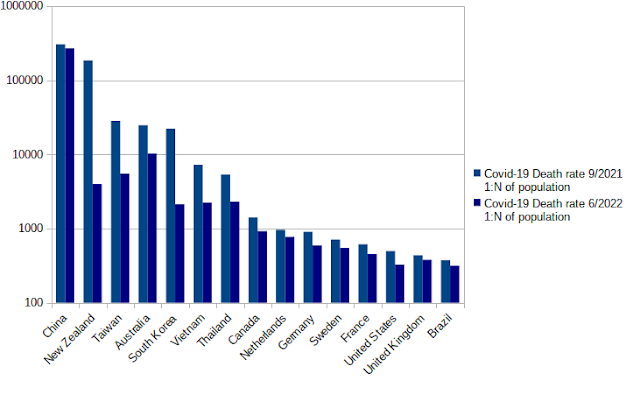
New Zealand's fall from grace is spectacular with a two orders of magnitude worse outcome now in comparison with nine months ago, the total number of deaths recorded having increased from 27 at the start of September last year to 1261 today. This rapid increase in deaths didn't take a whole nine months but actually only two, resulting from Jacinda Ardern deciding to open the country's borders to tourists from April 2022, resulting in rapid spread of Covid. I suspect that Bob Muldoon would now be impressed by Ardern, if he had lived to see this extreme example of putting business ahead of public health. Similar public health policy failures have resulted in similar results in Taiwan which went from 837 deaths to 4280 and South Korea which went from 2327 to 24388 over a similar period.
These countries once had a huge advantage over European and American nations which never bothered to protect their citizens but now it has almost entirely been squandered. China is the only country which now seems to be fully committed to protecting its population from disease, and especially the multitudinous long term consequences for health which are becoming known as long covid.